

Travelling on the Bernina Express – a Journey Through the Swiss Alps
Some train journeys are about getting from A to B. Others are about the landscapes in-between. Travelling on the Bernina Express firmly falls into the second category.
In just four hours, the train links high Alpine scenery with the Italian border, passing through the mountains, past lakes and glaciers. It’s a fabulous feat of engineering and a world-famous, scenic train journey.
All Aboard in Chur
You board the train in Chur, Switzerland’s oldest town, a beautiful place to explore if you’re overnighting here or have time to spare before departure. The old town is the perfect place to linger, with its 12th century Cathedral and mix of medieval, Baroque and Gothic architecture.
At Chur station, the Bernina Express is instantly recognisable with its bright red carriages and large panoramic windows, designed to maximise your view of the scenery.
And the scenic journey starts almost as soon as you leave the station. The train quickly climbs into the Albula Valley, threading through forests and small villages into the mountains and towards that most famous and often photographed landmark, the Landwasser Viaduct.
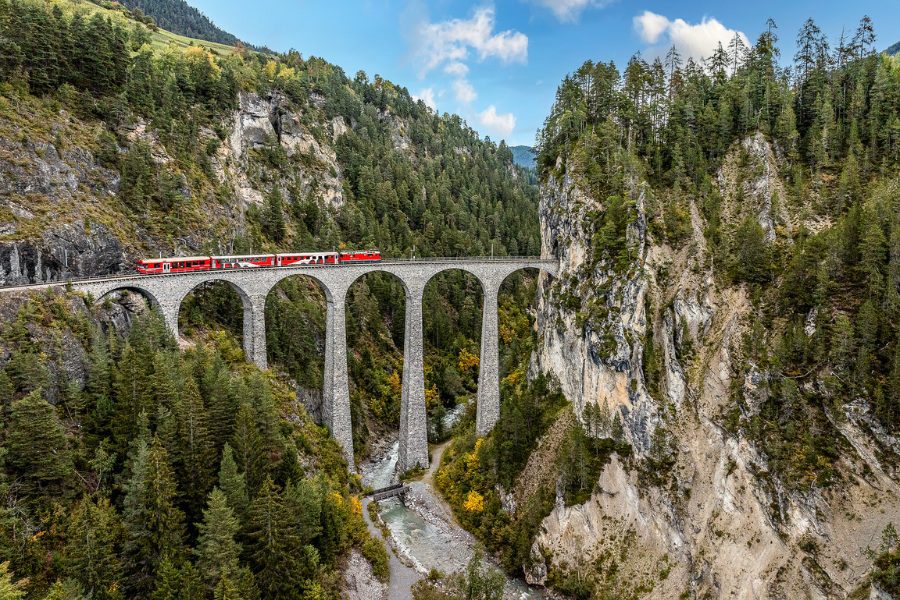
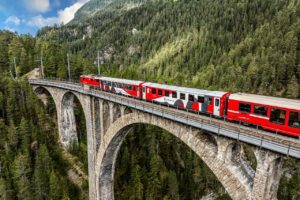
Crossing the Landwasser Viaduct
The train barely slows as it glides across the Landwasser Viaduct, a visually spectacular engineering marvel. The limestone bridge rises dramatically above a deep gorge before the track curves straight into a tunnel cut into the cliff face.
The Bernina route was built between the late 19th and early 20th centuries, and sections of it now form the Rhaetian Railway in the Albula / Bernina Landscapes, featuring impressive architecture like this along the way.
Climbing Towards the Bernina Pass
After passing through the Albula Tunnel, the train enters the Engadine Valley and gradually begins to climb.
This part of the journey is where the landscapes begin to shift, and there is something new to see in every season. In early spring, patches of snow still cover the slopes and you can see the mountains reflected in the frozen lakes. Later in the year the scenery is completely different with green pastures and mountain flora in summer and deep autumn colours as the leaves turn by October.
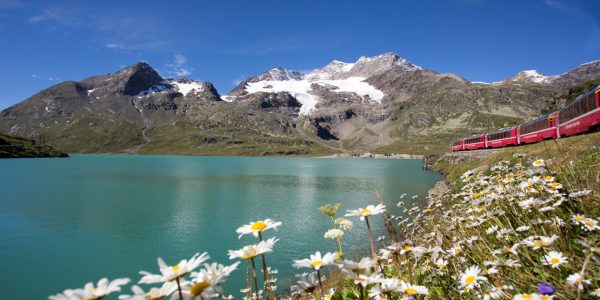
The railway eventually reaches its highest point at Ospizio Bernina, 2,253 metres above sea level. At this altitude the scenery feels almost Arctic with rocky terrain, glacial lakes and wide open skies.
Beside the tracks sits Lago Bianco, a pale lake coloured by glacial silt.
A Pause at Alp Grüm
One of the most memorable moments of the trip is Alp Grüm.
Many trains pause here briefly, giving passengers time to step onto the platform and look out over the Poschiavo Valley far below. On a clear day, you can see the Piz Palü Glacier and the mountains that surround it. Alight here for about ten minutes and take your photo of the stunning valley through the conveniently placed social media frame!
Spirals, Lakes and the Descent to Italy
From here, the Bernina Express begins its descent. The change in scenery happens quickly.
Snowy peaks gradually give way to forests and villages and the climate softens as the train approaches the Poschiavo Valley. The route passes along the edge of Lake Poschiavo, its deep blue water reflecting the mountains above.
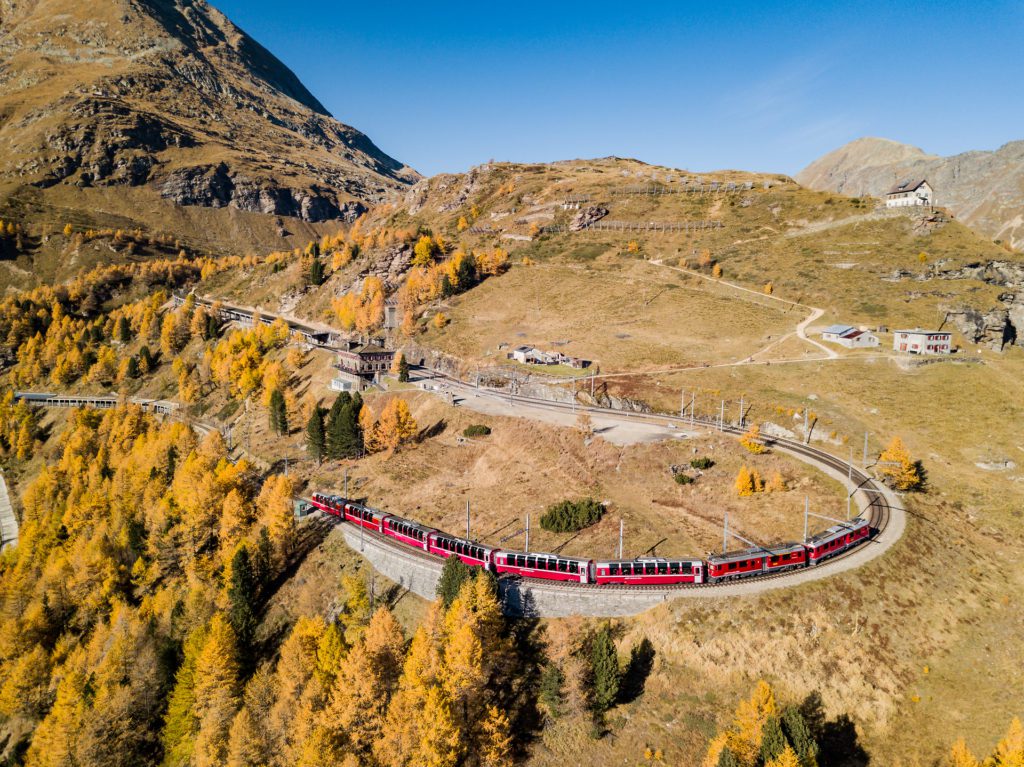
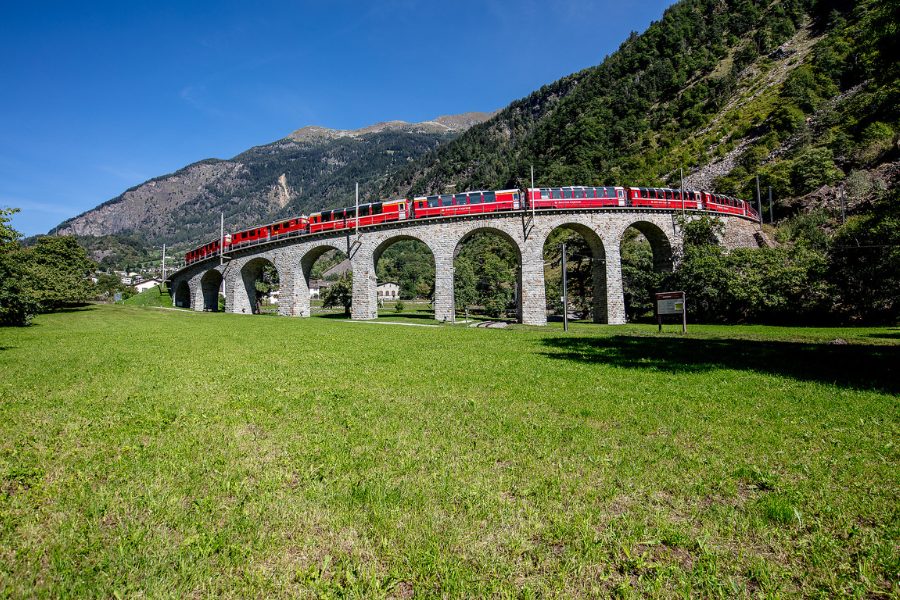
Soon after comes another engineering highlight: the Brusio Spiral Viaduct, another great photo opportunity.
The train loops in a full circle across the stone arches to manage the steep gradient. From inside the carriage you can actually see the front of the train curving around the viaduct, a clever solution to navigating Alpine terrain.
Arriving in Tirano
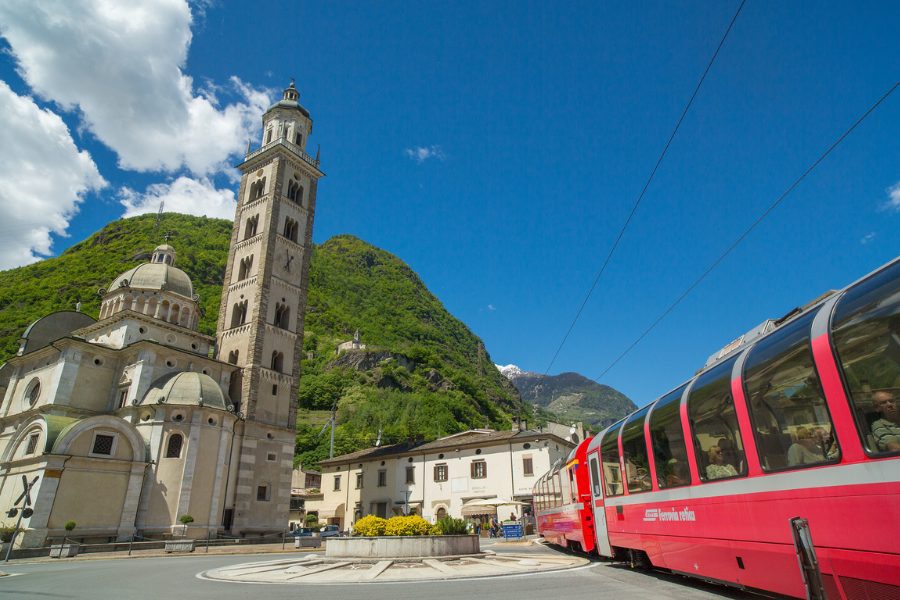
The final approach to Tirano is unlike anything earlier in the journey. The railway runs directly through the town streets, sharing space with cars and pedestrians.
After hours of glaciers and mountain passes, the town feels distinctly Italian. Cafés line the square outside the station, and many travellers take the opportunity to stop for lunch before continuing their journey.
Bernina Bus Extension
From Tirano, you can extend the route by road to Lugano on the Bernina Express Bus, which runs from February to November and takes passengers through the Italian Alps, past lakes and valleys, before returning to Switzerland.
A Railway Built for the Landscape
What makes the Bernina Express remarkable isn’t just the scenery, it’s the railway itself.
Across its 144-kilometre route the train passes through 55 tunnels and over 196 bridges, climbing steep gradients without the rack systems used on many mountain railways. The line combines the Albula Railway which was opened in 1904 and the Bernina Railway, completed in 1910, both now preserved as part of a UNESCO World Heritage route.
The Bernina Express covers a huge range of scenery in a relatively short time. In the space of a morning or afternoon, the train crosses glaciers, mountain passes, lakes and villages before arriving at the Italian border.
For anyone travelling through Switzerland by rail, it’s one of the journeys that stays with you long after the trip has finished.
And, like many of the great railway experiences in Europe, it’s best enjoyed at a relaxed pace with plenty of time to watch the Alps pass by the window.
Same route, different train
It is possible to travel on the Bernina route with a different experience – on local trains. You won’t benefit from the panoramic windows and reserved seats, but taking this option will provide greater flexibility to hop on and off the train. You might want to stay at the Alp Grum hotel for a coffee, lunch or even an overnight stay for example. Or, plan stops allowing you to take advantage of the excellent hiking opportunities along the route.
If this is an option that appeals, we have a blog here that gives you the inside track of travelling the same route on regular, regional services.
Holidays featuring the Bernina Express
Several of our pre-planned itineraries in both Switzerland and Italy feature the Bernina Express. And you can tailor-make a holiday including this journey in the region. You could even combine it with a ferry to Croatia and continue down to Montenegro.
Remember, all of our pre-planned holidays can be used as a starting point. Destinations and overnight stays can be added or removed, increased or decreased – as long as the rail timetable can accommodate your plans. We are on hand to advise throughout – from planning, route and hotel advice to booking your ideal departure time and train seat configuration.
You can talk to one of our friendly team on the phone, on a video call or in person, or send us an initial enquiry to start planning your Bernina Express holiday by rail.
Recent Posts
Recommended Itineraries


Share this post






Featured Destinations