


The Best Gardens in Europe to Visit by Train
Europe has some wonderful gardens, from the famous tulip displays of the Netherlands to the Renaissance gardens of Florence and the Moorish courtyards of Granada.
Some are at their most colourful for just a few weeks each spring, while others have something to offer throughout the year. And with many of them within easy reach of a railway station, it’s easy to include a garden visit in a European rail holiday.
Here are six of our favourites, along with the best times to visit and how to get there by train.
Keukenhof – Lisse, Netherlands
Every spring, around seven million flower bulbs burst into bloom at Keukenhof, near the Dutch town of Lisse. It’s one of the world’s largest flower gardens, attracting visitors from across the globe for its spectacular displays of tulips, daffodils and hyacinths.
The gardens cover 32 hectares, with winding paths, lakes, sculptures and a traditional Dutch windmill. Tulips are undoubtedly the stars, with hundreds of varieties in colours ranging from pale pink and yellow to deep purple and almost black. The displays are redesigned each year, so even regular visitors will find something different.
Keukenhof has a history stretching back to the 15th century, when the land was used to grow produce for the kitchen of Teylingen Castle. Its transformation into a flower garden came much later, in 1949, when a group of Dutch bulb growers decided to use the estate to showcase their flowers. The gardens opened to the public the following year, attracting 236,000 visitors in their first season.
There’s more to Keukenhof than tulips. Indoor pavilions host changing flower exhibitions, and the planting is carefully planned to provide colour throughout the short opening season. Early visitors will see crocuses, daffodils and hyacinths, while the later tulips generally reach their peak in April.
Keukenhof is open for only eight weeks each year, so it’s worth planning ahead. In 2027, the gardens will be open from 18 March to 9 May.
Our Dutch Delights by Rail holiday includes a stay in Amsterdam, making it a good choice for a spring visit. You could also add an extra night to give yourself more time in the area.
Getting there by train: Keukenhof is easily reached from Amsterdam or Leiden, with seasonal bus services connecting to the gardens, check ahead for the latest information.
Best time to visit: Late March to early May, with April generally the best month for tulips.
Keukenhof official website has more information.

The Dutch Bulb Fields, Netherlands
If you’ve ever seen photographs of the Dutch countryside covered in long, colourful stripes of flowers, you’ve probably been looking at the Bollenstreek, the bulb-growing region between Haarlem and Leiden.
Every spring, commercial flower fields turn the landscape into a patchwork of colour. Tulips are the best known, but there are also fields of daffodils and hyacinths, the latter filling the air with their distinctive scent.
Unlike Keukenhof, these aren’t ornamental gardens. The flowers are grown for their bulbs, and many are cut before they fade to help the bulbs develop. It’s an important part of the Dutch horticultural industry, which produces billions of flower bulbs each year.
One of the nicest ways to see the fields is by bicycle. The terrain is almost completely flat, with cycling routes linking small towns, villages and flower farms. You can also take a boat excursion from near Keukenhof, passing fields that are difficult to see from the road.
The flowering season is relatively short and depends on the weather, but April is usually the best time to see the tulips. Remember that these are working farms, so visitors should stay on the paths and roads rather than walking among the flowers.
Our Amsterdam and Delft holiday can be tailored to allow time for the bulb fields, or you could combine a visit with Keukenhof.
Getting there by train: Haarlem and Leiden are both easily reached by train from Amsterdam and make good starting points for exploring the region.
Best time to visit: April.
Visit Duin & Bollenstreek will give you more information.
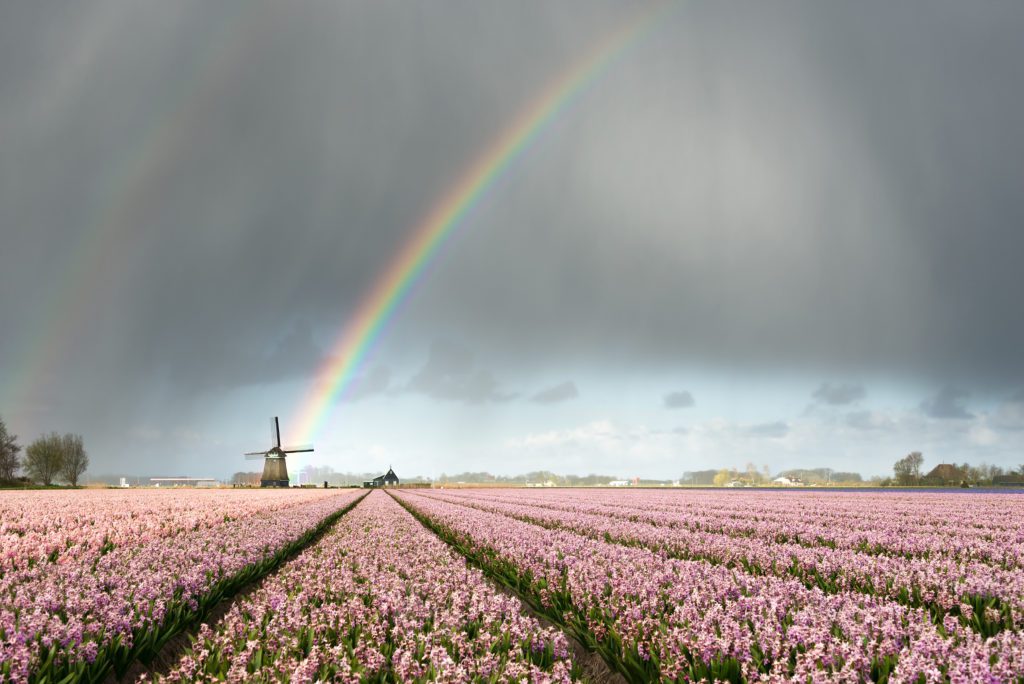
Bulb fields in Bollenstreek, Netherlands
Giverny Gardens – near Vernon, France
It’s difficult to look at the water lily pond at Giverny without recognising it from one of Claude Monet’s paintings. The artist lived here for more than 40 years, creating the gardens that would provide inspiration for some of his most famous work, including his Water Lilies series of around 250 paintings.
Monet was a keen gardener, taking a hands-on approach to planting and experimenting with colours and combinations of flowers. He employed several gardeners to help maintain the grounds, although he remained closely involved in their design.
There are two main areas to see. The Clos Normand, in front of the house, is packed with flowers arranged in informal beds, with climbing roses and arches covered in greenery. Across the road is the Japanese-inspired water garden, complete with its famous green bridge, wisteria and lily pond.
The gardens change considerably through the seasons. Spring brings tulips, forget-me-nots and wisteria, followed by roses and water lilies in summer. Monet’s house is also open to visitors, including his bright yellow dining room, blue kitchen and collection of Japanese prints.
Giverny is around an hour from Paris by train, making it a popular day trip. Many of our rail holidays pass through Paris, so it’s easy to add an extra night or two to visit Monet’s Garden before continuing your journey. Just ask one of our Travel Designers to include it in your plans.
Getting there by train: Take the train from Paris Saint-Lazare to Vernon-Giverny, followed by a seasonal shuttle bus to the village.
Best time to visit: April to October. Spring is particularly colourful, while the water lilies flower during the warmer months.
Visit the Fondation Claude Monet official website for more information about the gardens.

Mainau Island, Lake Constance, Germany
An entire island devoted to flowers? That’s Mainau, on Lake Constance in southern Germany, where around 45 hectares of gardens and parkland are filled with colour for much of the year.
Mainau has been associated with the Swedish royal Bernadotte family since 1932, when Count Lennart Bernadotte began transforming the island into a public garden. His descendants are still involved in running it today. Lake Constance’s mild climate allows an impressive variety of plants to flourish, including palms and citrus trees that you might not expect to find in Germany.
Spring brings thousands of tulips and daffodils, followed by rhododendrons and roses. If you’re visiting later in the year, the dahlia displays are a highlight of late summer and autumn. There’s also Germany’s second-largest butterfly house, an arboretum containing around 250 species of trees and an 18th-century Baroque palace.
The island is connected to the mainland by a bridge, but you can also arrive by boat across Lake Constance, enjoying views of the surrounding towns and mountains along the way.
Mainau is easily reached from Konstanz, which features on our Lake Constance & the Glacier Express holiday. This includes three nights in Konstanz, giving you plenty of time for a visit. Another option is our Heidelberg and Lake Constance holiday, with a stay in the lakeside town of Lindau.
Getting there by train: Travel to Konstanz, then take a local bus or seasonal boat to Mainau.
Best time to visit: April to September, although Mainau is open year-round and has seasonal displays throughout much of the year.
Mainau Island official website is the place to visit for up to date visitor info.

The Generalife Gardens, Granada, Spain
Water is everywhere in the Generalife Gardens, from narrow channels running alongside pathways to fountains and pools in the courtyards. In the heat of southern Spain, it’s easy to understand why the Nasrid rulers of Granada chose this hillside setting for their summer retreat.
The Generalife forms part of the Alhambra complex, one of Spain’s most important historic sites. Its gardens date back to the 13th and 14th centuries, although they’ve been altered and replanted many times since.
One of the highlights is the Patio de la Acequia, a long courtyard with a central water channel, fountains and flowerbeds. Cypress-lined paths lead to terraces and shaded courtyards, with views across to the Alhambra palaces and the city of Granada below.
Spring is a particularly good time to visit, when flowers are in bloom and temperatures are generally more comfortable for exploring. The gardens are attractive throughout much of the year, though, and it’s worth allowing plenty of time to see the wider Alhambra complex. Be sure to book tickets well in advance.
Our Andalucia in Depth holiday includes three nights in Granada, giving you time to see the Alhambra and Generalife Gardens. The itinerary also takes in Cordoba, Seville and Ronda, with plenty of opportunities to enjoy the region’s architecture, history and food.
Getting there by train: Granada has rail connections with Madrid and other Spanish cities. The Alhambra and Generalife can be reached from central Granada by local bus or taxi.
Best time to visit: April to June and September to October.
Visit the Alhambra and Generalife official website

Boboli Gardens, Florence, Italy
The Medici family certainly knew how to make an impression. Behind their vast Pitti Palace in Florence, they created one of Italy’s most influential Renaissance gardens, complete with fountains, elaborate grottoes, classical sculptures and sweeping views across the city.
Work began on the Boboli Gardens in the 16th century, and their formal layout helped establish a style of garden design that would later become popular across Europe.
Don’t miss the Buontalenti Grotto, an elaborate artificial cave decorated with sculptures, stalactite-like formations and intricate stonework. There’s also an amphitheatre, the Fountain of Neptune and long avenues lined with mature trees.
Boboli isn’t primarily a flower garden. Much of its appeal comes from the architecture and the way the gardens have been arranged across the hillside. It’s a lovely place to spend a few hours away from Florence’s busy streets, although some of the paths are quite steep.
You can visit the gardens during our Florence & Sorrento by Rail holiday, which includes two nights in Florence before continuing south to the Bay of Naples. Our Venice, Rome and Florence holiday is another option.
Getting there by train: Florence is well connected to Rome, Bologna, Venice and Milan by high-speed rail. The gardens are directly behind the Pitti Palace, within walking distance of the historic centre.
Best time to visit: April to June and September to October.
Boboli Gardens official website will tell you about events happening throughout the year.

When is the best time to visit Europe’s gardens?
Spring is an excellent time for garden lovers, particularly in the Netherlands, where the tulip season is relatively short. April is also a good month for Monet’s Garden and Mainau Island, while the gardens of Granada and Florence are pleasant to visit before the summer heat.
There’s plenty to see later in the year too. Mainau has colourful displays through summer and autumn, and Monet’s Garden changes throughout its opening season.
If you’re planning a holiday around a particular garden, it’s worth checking the flowering season and opening dates before you book.
Include a garden visit in your rail holiday
You don’t need to plan an entire holiday around gardens to enjoy some of Europe’s finest. Many can be visited as day trips from cities already featured in our rail holidays, or included by adding an extra night or two to your itinerary.
There are plenty of other gardens worth seeking out too. Cities across Europe have botanical gardens, arboretums and large parks, from the gardens of Schönbrunn Palace in Vienna to the Jardin des Plantes in Paris and Copenhagen’s Botanical Garden. Many can easily be included in a day of sightseeing.
Our Travel Designers can help you plan a rail holiday that includes the gardens you’d most like to see, alongside other places that interest you. We’ll arrange your trains and hotels, with an itinerary tailored to your plans.
Browse our rail holidays or contact us to discuss your ideas.
Recent Posts



Recommended Itineraries


Share this post